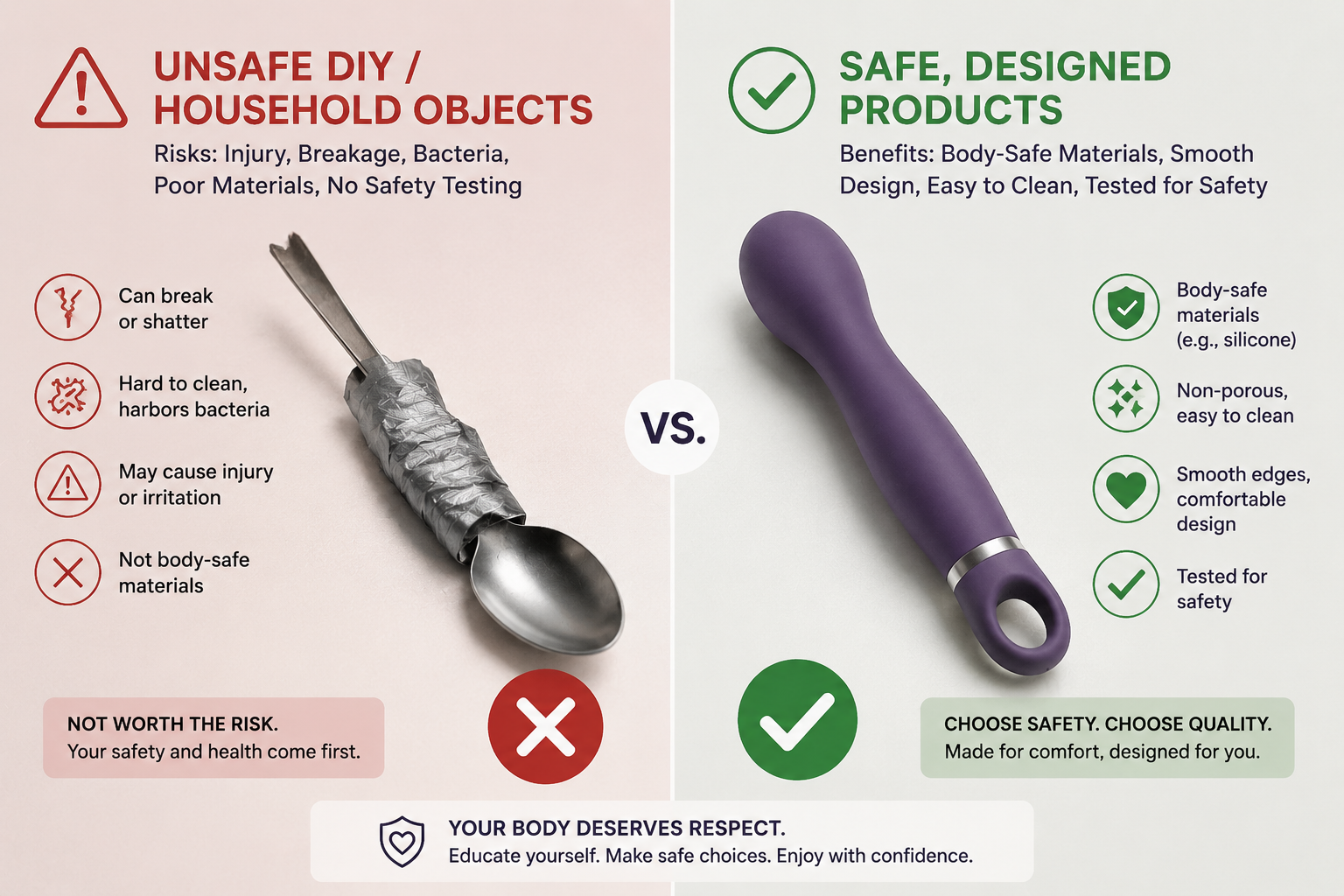
DIY projects and online bargains can be appealing when money or privacy is a concern. But an object that works for a household task has not necessarily been designed for intimate contact. This guide compares improvised objects with purpose-built adult products and explains what to check before buying.
The useful distinction is evidence, not price. A commercially made product can offer documented materials, intended-use instructions and a traceable manufacturer. Buying from a store, spending more or seeing the words “body-safe” does not by itself establish that a particular product is suitable for you.
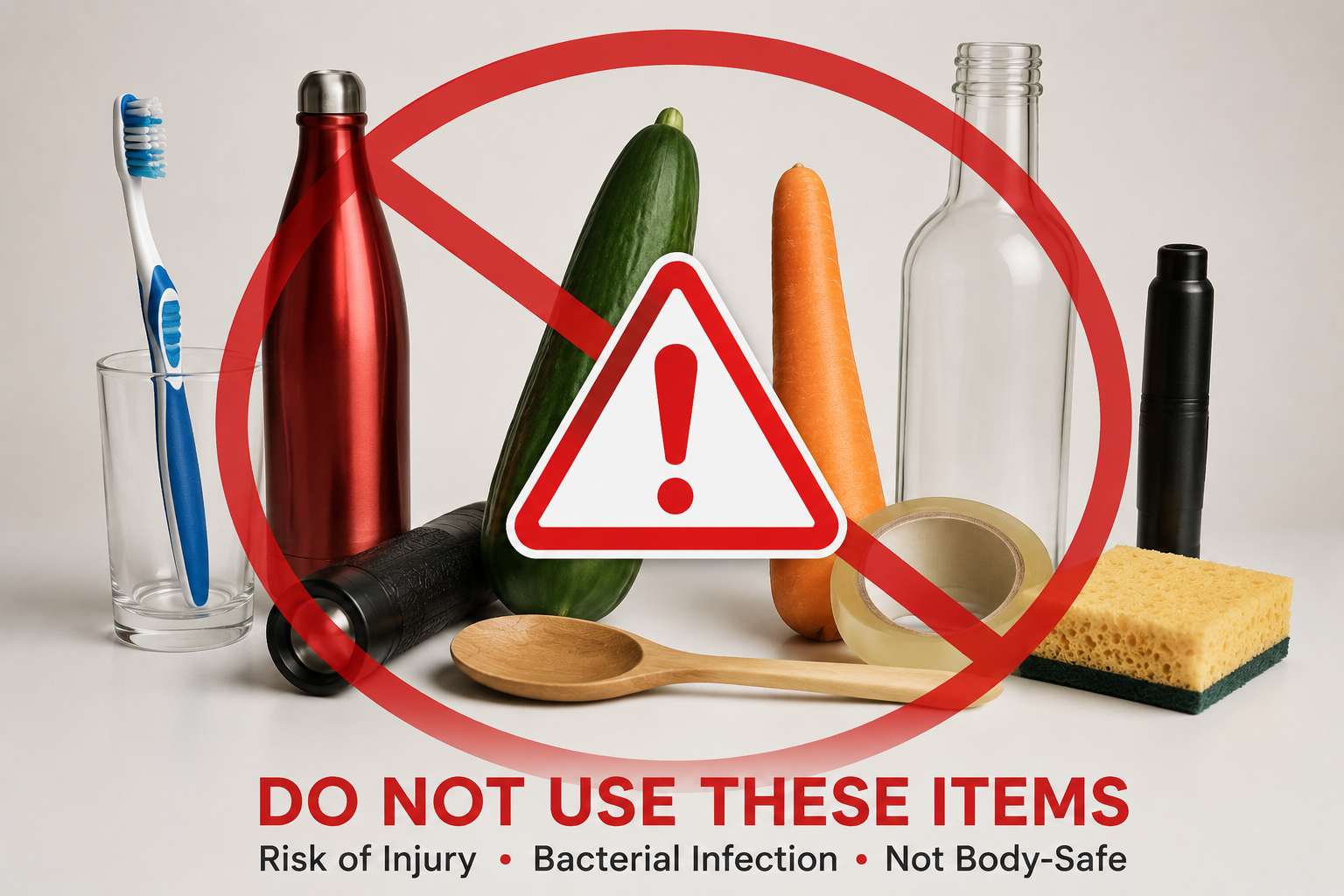
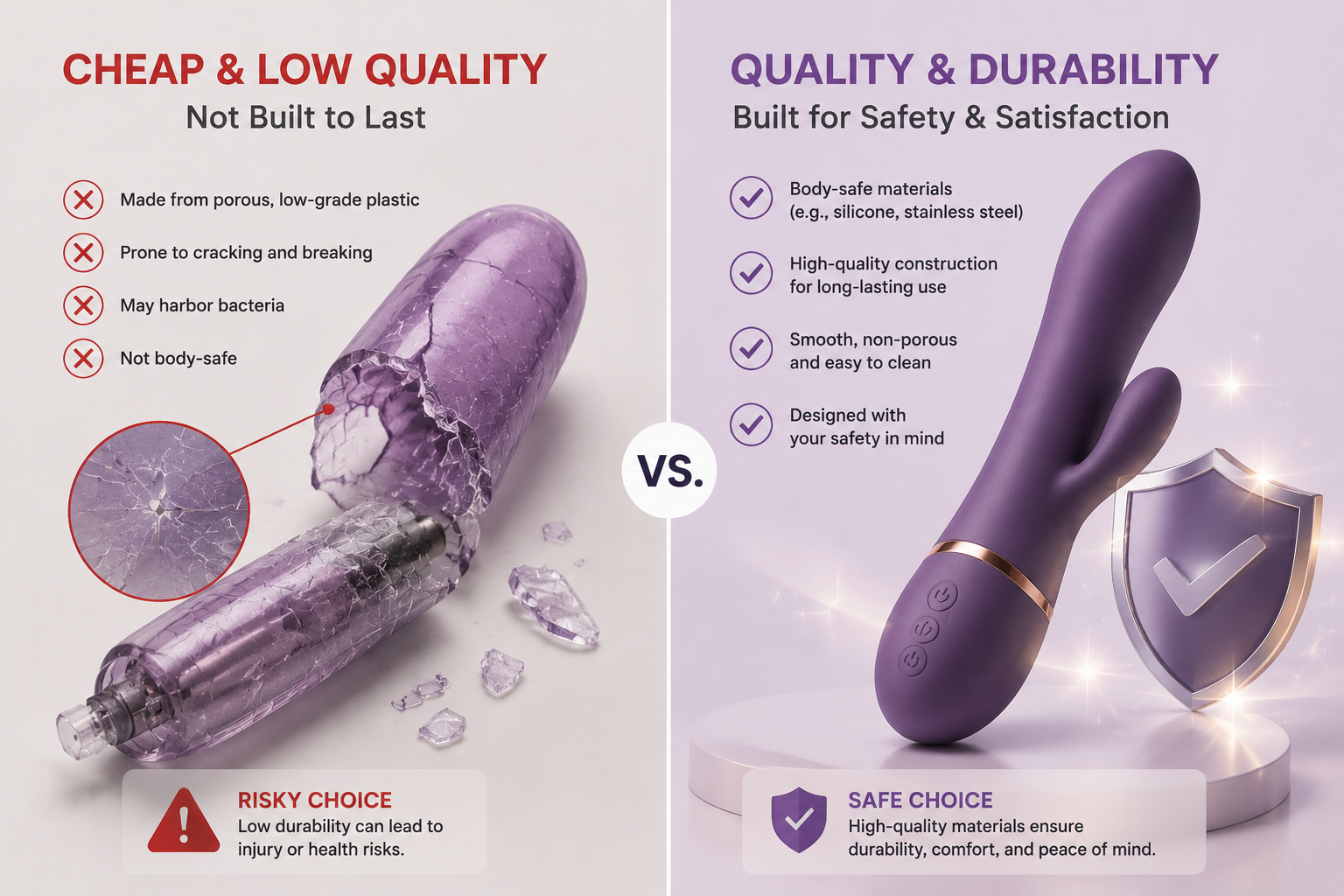
About the illustrations: the original comparison graphics are conceptual examples. Their “safe,” “tested” and material labels are not test results or certifications for the pictured designs or products in our collection. No product is risk-free, and low price alone does not establish poor quality.
Why DIY Can Seem Appealing
Cost, convenience, privacy and curiosity can all motivate someone to consider an improvised object. Those concerns are understandable. The difficulty is that familiar appearance, a smooth surface or a “food-safe” label does not answer the questions relevant to a different kind of bodily contact.
For an intimate product, you need to know its intended use, the materials at the contact surface, how its parts hold together and how it can be cleaned. A household object or home-printed item will usually not come with that information for intimate use. This article does not provide instructions for building or adapting one.
Four Risks an Improvised Object May Leave Unanswered
Shape, strength and retrieval
Rough edges, brittle parts, weak joins and detachable components can cause problems even when an object initially looks intact. An item intended for insertion needs design features appropriate to that use. In particular, an item not designed for anal use may lack a suitable retention base and become retained. A household object should not be treated as suitable simply because its size or shape seems convenient.
Materials and surface finishes
Paint, adhesives, coatings, printing resins and other craft materials may not have been assessed for the intended contact. A generic material name is not enough: formulation, pigments, processing and the finished surface matter. A plastic suitable for one manufactured product is not automatically suitable in a home-printed version.
Do not try to identify chemical content through a smell, flame or other home test. A strong or changed smell can be a reason to stop using an item and seek information, but it does not tell you which chemicals are present. The absence of an odor is not proof of safety either.
Cleaning and contamination
Cracks, porous surfaces and inaccessible seams can make cleaning difficult. “Non-porous” does not mean sterile: contamination can remain on any surface, and cleaning requirements depend on the complete product. Covering an unsuitable object with a barrier does not fix its strength, shape, electrical or retrieval problems.
For a purpose-built product, follow the manufacturer’s cleaning instructions. Do not assume it can be boiled, put in a dishwasher or submerged. Our water-resistance guide explains why a rating must be read alongside the instructions.
Electrical and mechanical reliability
Modified household electronics may expose users to moving parts, heat, electrical faults or components that were never designed for intimate contact. Do not adapt powered tools, chargers or motors for this purpose. Even a manufactured adult device must be used with the specified power supply and within its stated water-resistance and operating limits.
What a Purpose-Built Product Can Offer
A well-documented product gives you information to evaluate rather than leaving you to guess. Look for these practical advantages, and verify them for the specific model:
- Clear intended use: a description of the contact and use the manufacturer designed the product for, including restrictions.
- Identifiable materials: information about the contact surface and any coatings, not only a broad label or a photograph.
- Appropriate construction: dimensions, retention features where relevant, secure components and instructions for inspecting wear or damage.
- Model-specific instructions: cleaning, drying, storage, lubricant compatibility, power supply and water-resistance guidance.
- Traceability and support: an identifiable manufacturer, model or batch information, reachable support and a way to check recalls.
- Relevant evidence: test information that identifies the product, the standard or test method and what was actually assessed.
These are questions to ask, not assurances that every commercially sold item satisfies them. A warranty is useful for resolving faults; it is not a medical-safety certificate. Reviews can reveal practical experiences, but they cannot replace material or design testing.
Read Safety Claims in Context
Terms such as “medical-grade,” “hypoallergenic,” “non-toxic,” “BPA-free” and “phthalate-free” should prompt a question about the supporting evidence and its scope. A claim about one substance or material does not establish the safety of an entire device, and no material label guarantees freedom from irritation or allergy. Our materials comparison covers questions about surfaces and care.
ISO 3533:2021 addresses material, design and user-information safety requirements for manufactured products intended for direct genital or anal contact. A seller mentioning the standard is not proof that a model has been assessed against it. Ask what documentation supports the claim and whether it covers the exact model.
- CE marking: indicates conformity with applicable EU requirements for product categories that require it. The European Commission explains that it is not EU-authority approval that a product is safe. It is not a blanket intimate-contact certificate.
- RoHS: concerns restrictions on specified hazardous substances in electrical and electronic equipment. Its official scope does not amount to an assessment of every intimate-use risk.
- REACH: is an EU chemicals regulatory framework. A broad compliance statement should not be read as a finished-product medical or intimate-contact approval.
- California Proposition 65: is a chemical-exposure warning system. The official FAQ explains that a warning does not itself mean a product violates safety standards. Neither a warning nor its absence is an all-purpose safety rating.
These systems have different purposes. Do not treat their names or logos as interchangeable certificates, and do not assume that general consumer-product obligations are optional simply because a listing says “novelty use only.”
Choosing on a Budget
An affordable product can still be a reasonable choice, and an expensive one can still have defects or unclear documentation. Compare a simpler, well-documented model with a more complicated one before paying for extra features. Our budget and premium comparison offers a practical way to weigh those differences.
- Check the actual seller and manufacturer, rather than relying on a marketplace’s name.
- Confirm the model, intended use, dimensions and contact materials before purchase.
- Ask for missing cleaning, compatibility or test information. Vague reassurance is not a substitute for a specific answer.
- Read the warranty and return terms, including hygiene-related exclusions, before opening the package.
- Keep the instructions and identifying information so you can check support notices or recalls later.
Privacy also matters. Ask the retailer about packaging and billing if those affect your decision; do not assume any merchant guarantees anonymity. Choosing to wait until you have reliable information is a valid option.
After Purchase: Inspection and Care Still Matter
Inspect a product before use. Stop using it if it cracks, tears, develops a damaged coating, exposes internal parts, overheats or behaves unexpectedly. If the surface changes or you experience irritation, stop and ask the manufacturer or a healthcare professional as appropriate. Do not repair a body-contact surface with household glue or tape.
Cleaning and use instructions apply even to a new or premium product. For hygiene considerations when sharing, see our safer-sharing checklist. Product advice cannot diagnose symptoms or replace individual healthcare guidance.
The Bottom Line
Purpose-built products can reduce the uncertainty of improvising when they come with appropriate design, evidence and clear instructions. Choose on that basis rather than price, appearance or reassuring slogans. Understanding a product’s limits, using it only as intended and maintaining it properly remain important at every budget.