Do not boil an assembled vibrator. A silicone exterior, a waterproof claim or a removable battery is not permission to heat the complete device. Some manufacturers allow boiling particular non-powered silicone toys or detachable parts, but that permission must apply to the exact item—and does not include its electronic component.
If you are looking for a more thorough cleaning method, start by identifying what the instructions actually authorize. The important distinction is not simply silicone versus plastic. It is the complete product versus a specific part, and an explicit care method versus an assumption.
Three Manufacturer Instructions, Three Different Boundaries
These current manufacturer instructions illustrate why a generic material chart cannot settle the question. They describe the makers’ own products; none is a universal rule for other brands.
We-Vibe’s care guidance says not to boil, bake or microwave its toy, charging base, cable or remote, or put them in a dishwasher. It gives a cleaning routine instead. The fact that its toy uses silicone does not cancel that restriction.
Aneros’s care page covers rigid products as well as flexible silicone products, yet prohibits boiling its products and warns that doing so causes deformation. This is a useful counterexample to the claim that any non-electronic silicone toy can automatically go into a pot.
Tantus’s FAQ allows a boiling method for its boilable silicone toys and specifically requires removing the vibrator or other electronic component first. The limiting word is “boilable.” This is permission for qualifying silicone items, not for an entire vibrating assembly or every product labeled silicone.
The practical conclusion is narrow: use the exact product’s instructions, not another manufacturer’s permission. A direction for a removable silicone body cannot be transferred to the motor insert, controller or charging accessories.
Separate the Three Claims
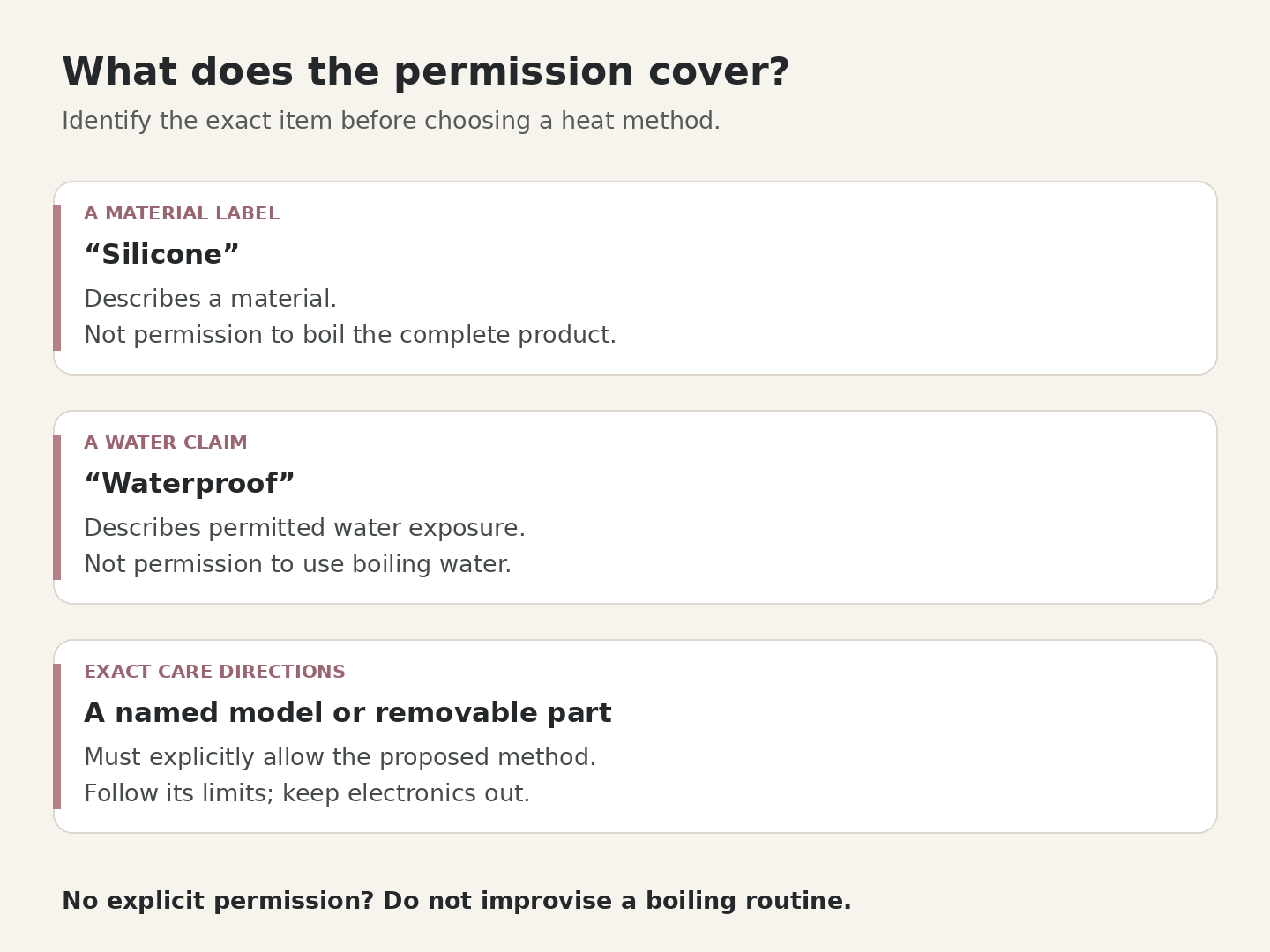
A material label identifies something used in construction. A water-resistance claim concerns water exposure under its stated conditions. A cleaning instruction authorizes a method for a named item. Those are different kinds of information. Our water-resistance guide explains why a water rating also needs its conditions and accessory limits.
For example, removing an AA battery does not turn a vibrator into a solid silicone object: the motor, controls and other parts remain. Likewise, an attachment that comes off does not necessarily qualify for boiling. Its own care directions still need to permit heat.
When a Removable Part Has Its Own Instructions
Treat a product set as separate care items only where the manufacturer designed it that way. An approved removable motor insert and a sealed motor housing are not the same thing. Do not cut, pry open or dismantle a sealed device to make it fit advice intended for detachable components.
Before using a permitted heat method, check four details in the instructions: the exact model or part named; what must be removed; the specified method and duration; and the cooling and drying steps before reassembly. If any of those are unclear, ask the manufacturer rather than borrowing a time from a general guide.
There is no universal boiling time to recommend here. Even where a manufacturer permits boiling, its procedure belongs to that qualifying product. Longer is not automatically better, and a permitted boiling procedure does not authorize a microwave, dishwasher or steam-cleaning substitute.
If the Instructions Are Missing—or You Already Used Heat
Without explicit permission, skip boiling and obtain the model’s care guide. If you already have an approved routine, continue to follow it rather than adding heat. Our everyday cleaning and storage guide covers the ordinary care sequence; toy cleaner versus soap addresses choosing a compatible cleaning product.
If a vibrator has already been boiled contrary to its instructions, keep it out of use and do not charge it while seeking manufacturer advice. Give support the model, what was heated, the method and approximate duration, and any visible change. Switching on successfully or looking unchanged is not confirmation that the manufacturer considers it suitable for continued use. Do not repeat the exposure as a test.
If the reason you want a stronger cleaning method is a concern about infection or sharing, do not treat boiling as a blanket guarantee. That is a separate question from whether the product tolerates heat. Use the sharing and cleaning checklist and seek qualified health advice for a personal infection concern.
Make Care Instructions Part of the Purchase Decision
When comparing the current product range, ask for care directions before choosing a model if a particular cleaning method matters to you. Material and power specifications help you frame the question, but they do not establish that any listed product is boilable.
A useful question is: “For this exact model, is boiling permitted at all? If so, which removable non-powered part does that permission cover, and where are its complete instructions?” A clear answer is more valuable than a broad “easy to clean” claim. Choose a routine you can follow without inventing an extra heat treatment.