A “soft” silicone sex toy from one maker is not necessarily softer than a “medium” one from another. Start with the complete Shore hardness rating, when one is provided, and identify which material or layer it describes. Then compare the finished design. Neither a marketing label nor a hardness number can promise a particular feeling.
For adult women shopping online, that distinction can prevent a misleading comparison. Firmness guides are especially common for molded silicone toys; do not assume that every vibrator supplies the same kind of specification.
One Rating, Two Different Names
Here is a concrete example from manufacturer guides checked for this November 1, 2026 guide: Godemiche calls Shore 00-50 “Soft,” while Creature Feature Toys calls 00-50 “Medium.” The adjective changes even though the stated number and scale match.
This does not establish that two finished toys will feel identical. It shows why moving from one brand's “medium” to another's “soft” is not a reliable way to select a softer material. Read each maker's firmness key rather than carrying a label across brands. These are published descriptions, not our laboratory measurements or hands-on reviews.
Keep the Scale Attached to the Number
Shore hardness describes resistance to indentation: how a material resists being pressed into by a measuring instrument. Smooth-On's technical explanation distinguishes several scales, including Shore 00 for very soft rubbers and gels and Shore A for a range of flexible rubbers. The scales overlap; they are not one continuous number line.
So “30” is incomplete. Shore 00-30 and Shore 30A are not interchangeable labels. Do not drop the zeros or letters in your comparison notes, or rank ratings from different scales by the larger bare number. Ask for the full notation if a listing omits it.
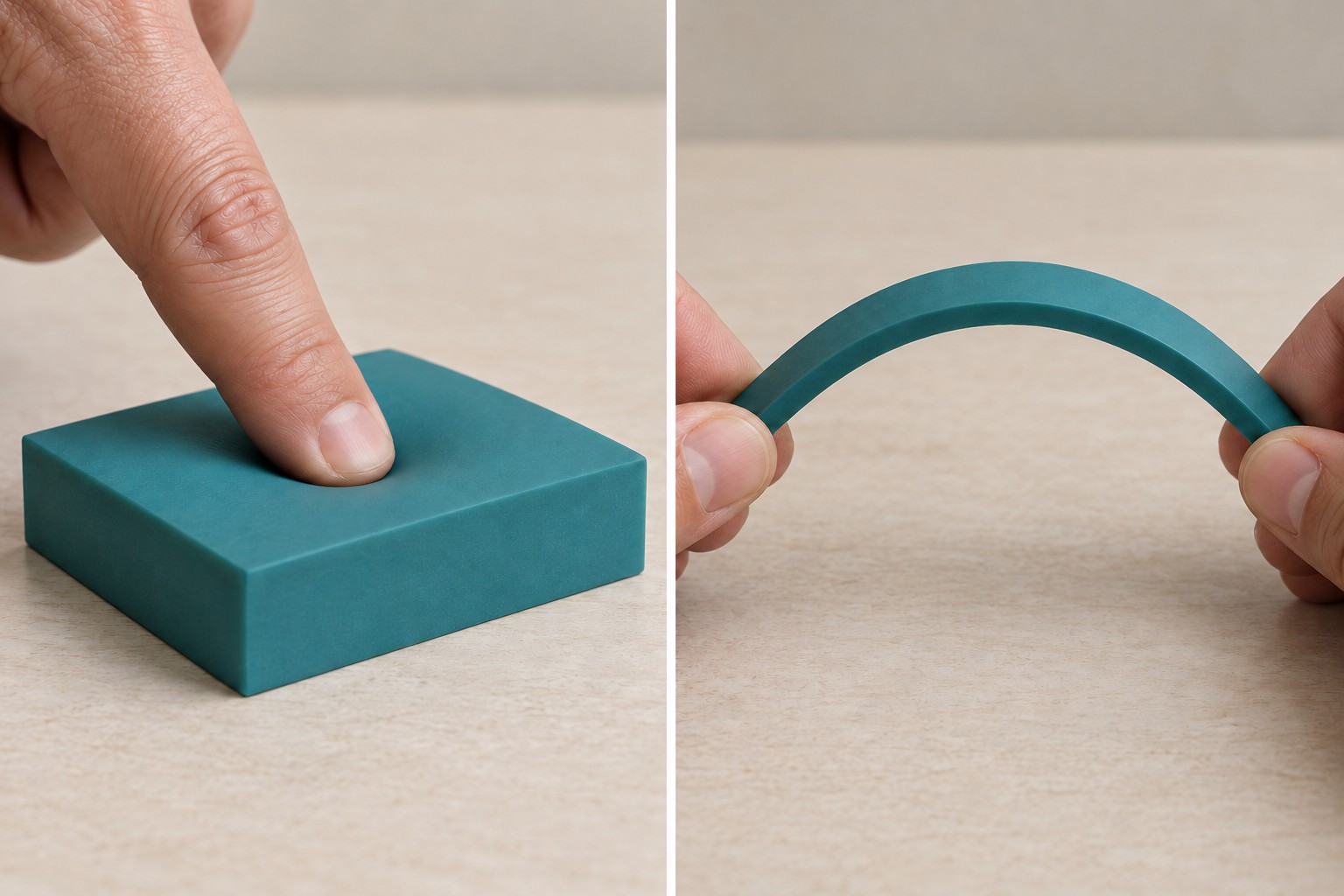
The illustration separates local indentation on the left from bending a whole strip on the right. These are conceptual samples with different shapes, not a controlled comparison, a Shore test or evidence of any product's rating. A hand demonstration can help show how an item moves, but it cannot supply a standardized hardness measurement.
Nor is hardness a comfort score, material-safety certificate or measure of vibration strength. A clearly stated rating answers a narrower question; it does not remove the need to check intended use, dimensions and construction.
A Layered Toy Needs More Than One Answer
A listing can quote a real hardness value yet leave out the part that matters to your comparison. Does it describe the outside, an inner core, or the material used throughout a single-piece molding?
For example, PRIS Toys describes its dual-density models as a Shore 00-30 outer layer over a Shore 30A core and base. Recording only “30” would erase both the different scales and the different locations. Recording only the outer rating would leave out the core. This is one maker's construction, not a definition that applies to every product sold as dual density.
Treat “dual density” as a prompt to investigate the layers, not as a universal firmness grade. Ask which layers are present and what the supplied rating refers to. For a powered toy, a silicone surface may also sit over a rigid housing; an exterior material description does not describe the whole assembly.
Compare Like With Like Before Choosing
Love Smiths' firmness guide notes that shape, dimensions and internal structure affect the finished result. A long, narrow section and a short, thick section made from the same material need not bend alike. That is why a sample or demonstration is most useful when you know exactly what it represents.
Keep the exact size and version beside the firmness information. Our product-dimensions guide covers length, width and shape; the smooth-versus-textured guide deals with a separate question: the surface profile you can see.
For a local listing example, the OMIREA Primal PM7V52 is described as flexible silicone. That description is not a Shore rating, so it should not be placed on a numerical firmness scale without further manufacturer information. Missing data should remain missing, not become a guessed score.
Before ordering, write a short comparison note: the maker's firmness name; the complete Shore rating if available; which layer it covers; and the exact size and construction. If a sample is offered, check that it represents the option you are considering, while remembering that a small sample cannot reproduce the finished shape.
A useful question is: “For this exact size and version, what does your firmness label mean, is a Shore rating available, and does it describe the outside, the core or both?” You do not need to find the highest or lowest rating. The aim is to understand what is being offered—and recognize what the available evidence cannot tell you.