A vibrator that switches off after about 20 minutes may be following a built-in timer rather than running out of charge. Check the instructions for your exact model: an advertised battery runtime of several hours does not promise several hours of uninterrupted operation. A matching time interval is a clue, not proof that the device is working normally.
Before restarting, look for any maximum continuous-use limit and required cooling period. Do not assume that a charged battery, a power cable, or a responsive power button overrides those instructions.
One Product Can Have More Than One Time Limit
The numbers on a product page can describe different things. Battery runtime estimates how much powered use a charge may provide under the manufacturer's stated conditions. An automatic shut-off interval describes when the device stops. A cooling instruction describes what you must do before using it again. None is a substitute for the others.
For example, LELO's Smart Wand 2 Medium specification page lists automatic shut-off after 20 minutes alongside up to two hours of user time.
The Smart Wand 2 Large manufacturer specifications also list a 20-minute automatic shut-off, but up to four hours of user time. The longer runtime figure does not remove the timer. These are manufacturer specifications, not our test results or a ranking of the products.
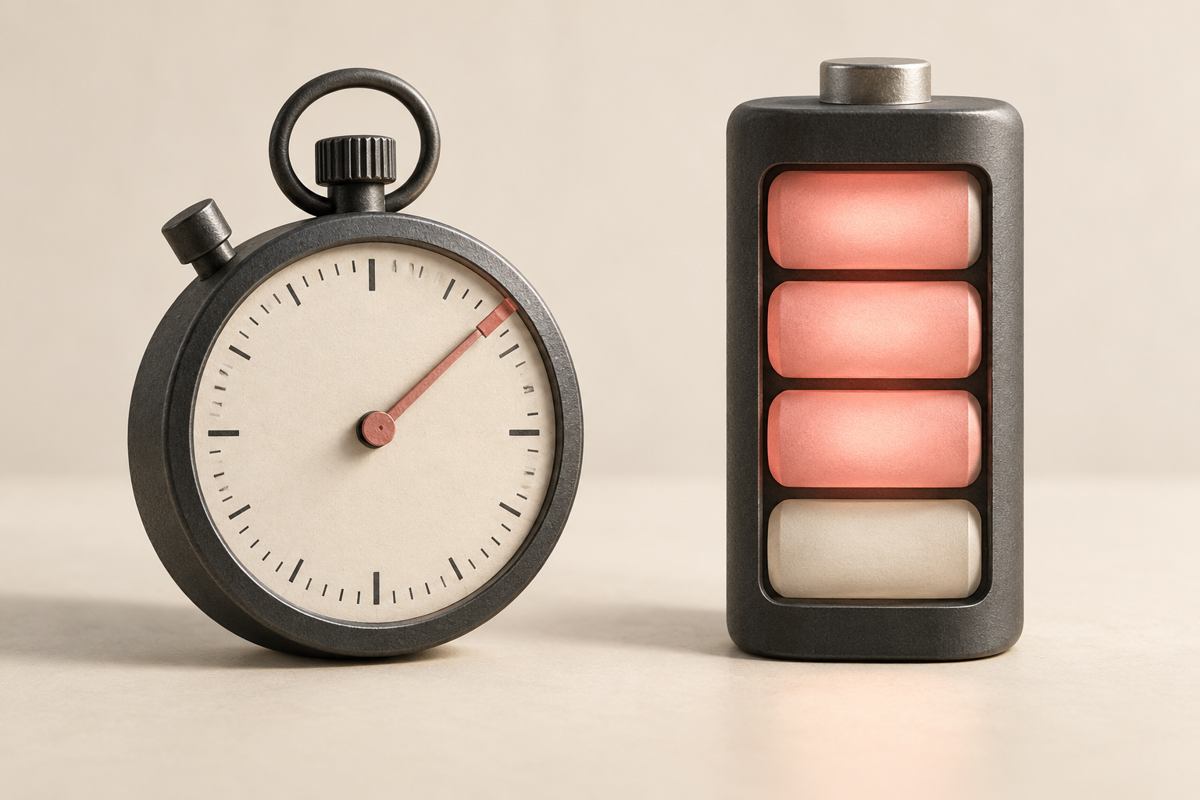
Think of the timer and battery as two separate gauges. One can reach its stopping point while energy remains in the other. The amount left is model- and use-dependent; you cannot calculate it from the shut-off interval alone.
Standby time is another separate figure: it concerns a device waiting between uses, not a motor running continuously. When comparing products, keep standby, charging time, and operating time in different columns of your notes.
What to Check When It Stops
- Check the exact model and manual version. A similar name or appearance does not establish that another model's instructions apply.
- Note roughly how long it had been running and what the indicator lights showed. Describe whether all functions stopped or only one; avoid treating every interruption as a flat battery.
- Find the manual's automatic shut-off, continuous-use, and cooling instructions. Read them together rather than looking only at the advertised runtime.
- If the behavior is unexplained, contact the manufacturer or seller with the model, elapsed time, settings, and indicator behavior. Do not repeatedly force it to run to reproduce a possible fault.
A predictable stop matching a documented timer may be expected. A stop well before that interval, unusual heat, visible damage, or erratic behavior needs a different response: stop using it and seek model-specific support rather than assuming the timer explains everything.
Restarting May Require a Pause
The Magic Wand Rechargeable HV-270 user manual provides a useful model-specific example. It instructs users to stop after 20 minutes and let the device cool before restarting. This linked copy is hosted by Manuals+, not the manufacturer's own website.
That instruction is not a universal cooling schedule for every vibrator. Use your own device's instructions, and ask support when the required pause is unclear. Do not disable a shut-off, open the casing, or modify the battery to extend operation.
Nor does plugging in automatically solve the problem. Whether a vibrator can be used while charging is a separate model-specific question; permission to operate on external power does not cancel operating limits.
A timer is an equipment feature, not a personalized recommendation for how long to continue. You do not need to wait for it to stop if you feel uncomfortable.
Ask About Interruptions Before You Buy
If uninterrupted control matters to you, an impressive runtime number is not enough. Ask the seller: “For this exact model and revision, what is the automatic shut-off interval, the maximum continuous operating time, and the required cooling period before restarting? Does the quoted runtime describe total battery use rather than one uninterrupted run?”
For a practical example of reading a listing carefully, the OMIREA Whisper WS9C72 lists approximately 45 minutes of use and 2.5 hours of charging. Those figures alone do not establish its automatic shut-off interval or maximum continuous-use limit. Ask for those details if they affect your choice; do not infer that an unlisted timer is absent.
Our rechargeable versus battery-operated guide covers the broader power-source decision. For interruptions, the more useful comparison is narrower: what stops the device, what the instructions require next, and whether that sequence fits your preferences.