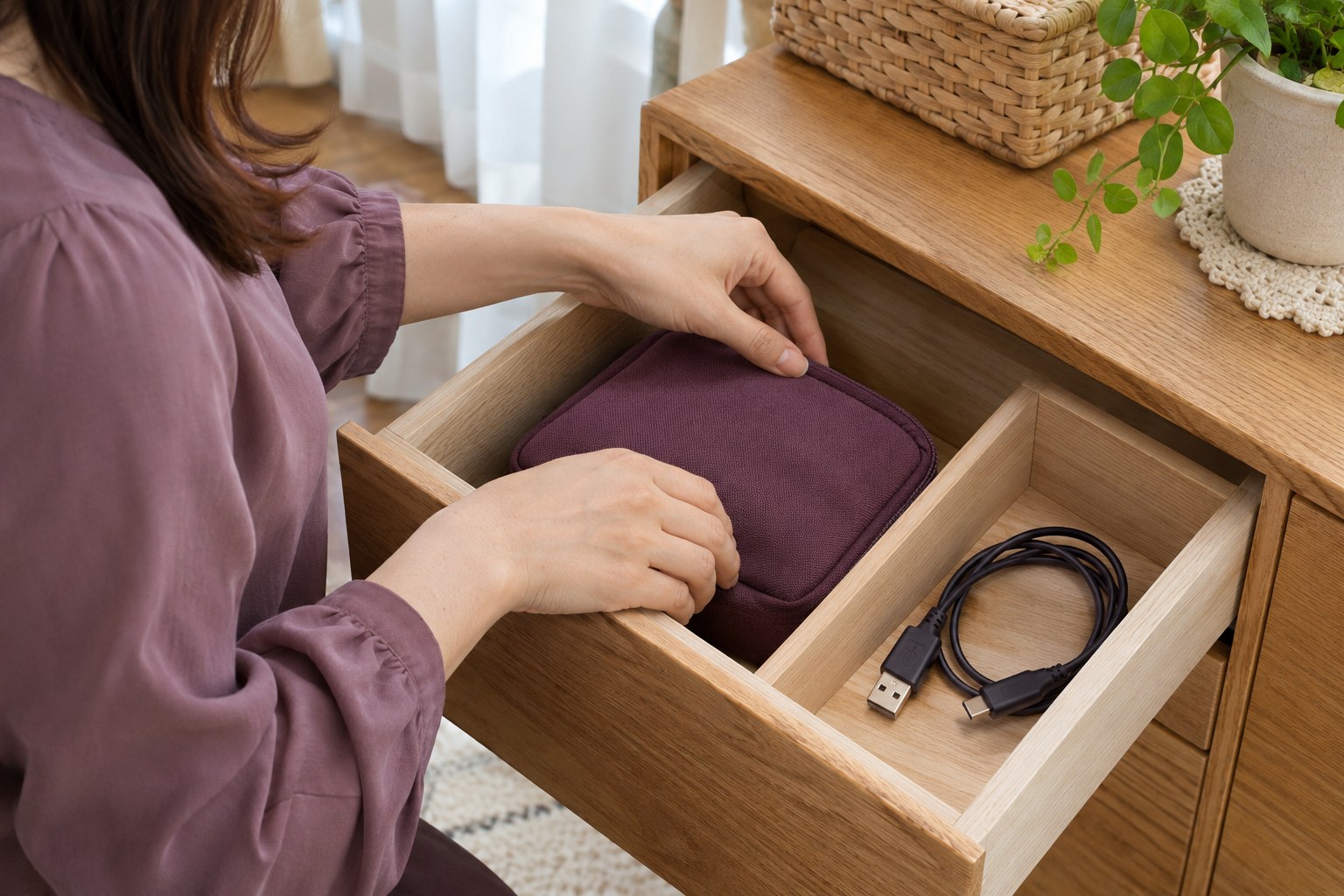
Choose a rechargeable vibrator if keeping a charging routine sounds easier than keeping spare batteries. Choose a replaceable-battery model if you prefer changing the specified cells when they run down. Neither power arrangement, by itself, tells you how strong, quiet, waterproof or comfortable a vibrator will be.
For an adult woman choosing a first vibrator or replacing an older one, the useful question is practical: what would make this device easy to keep ready in your home? Start with the product shape and controls you want, then compare how each option gets its power.
What do the two labels actually mean?
A rechargeable vibrator uses a battery that you recharge with the equipment specified for that model. “Battery-operated” in shop descriptions usually means removable cells, such as AA or AAA batteries, even though a cordless rechargeable vibrator also runs on a battery. Check the full specification rather than relying on the label.
There is a third possibility: a removable-battery device whose instructions permit rechargeable cells. Do not assume that permission from the battery size. FUN FACTORY’s battery-toy FAQ, for example, specifies ordinary 1.5-volt batteries and says not to use rechargeable ones for those products. That is a brand-specific instruction, not a rule for every vibrator.
See the manufacturer’s battery-toy instructions for this example; use your own model’s manual for the actual battery choice.
Compare the everyday trade-offs
| Your priority | Rechargeable | Replaceable batteries |
|---|---|---|
| Getting ready | Needs enough charge and the correct charging equipment. | Needs the correct cells installed; keep suitable spares if you want to avoid a wait. |
| When power runs out | Plan around the stated charging time. | Changing cells may restore use without charging the device, provided suitable fresh cells are available. |
| Handling | Check how easily you can align the connector and read its indicator. | Check whether you can open, close and correctly reload the compartment. |
| Long-term upkeep | Ask about battery service and replacement charging equipment. | Ask about the supported cell type and compartment care. |
| Ongoing cost | Include electricity and any required accessories or service. | Include replacement cells, or an approved cell charger if the model permits rechargeable cells. |
Which routine would actually work in your home?
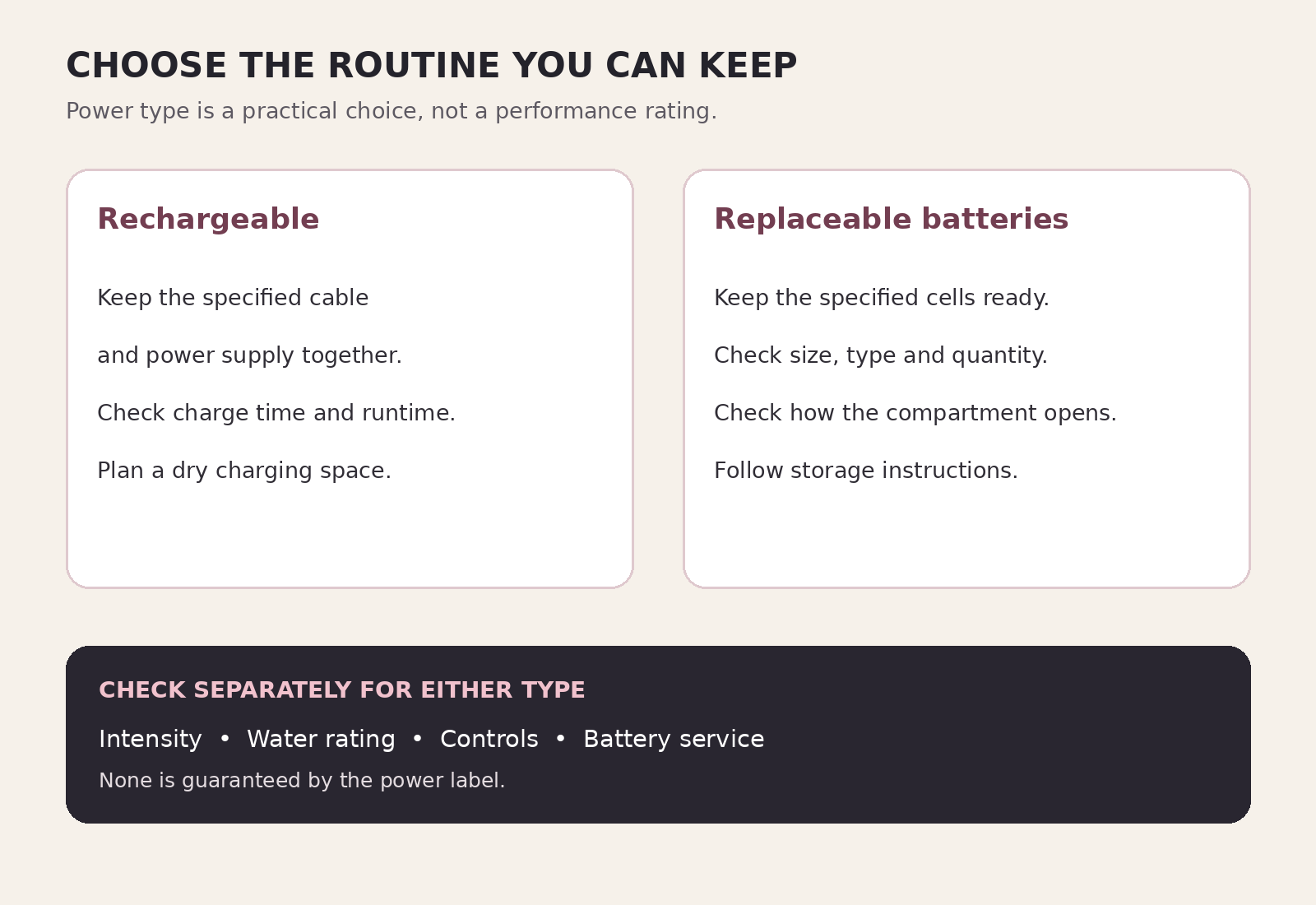
Picture the place where you would prepare and store the device. If there is a convenient, dry charging spot and you already keep small electronics charged, a rechargeable option may fit naturally. If another cable would be easy to lose, replaceable batteries may feel simpler—but only if you can keep the right cells available.
Think about access as well as convenience. A small twist cap may be awkward for someone with limited hand strength; a small charging connector can be awkward too. Ask for a clear picture or instructions showing the relevant part. Neither power category guarantees easier handling.
A separate remote adds another item to check. Its power arrangement may differ from the main device. Write down what each component requires instead of treating “rechargeable set” as a complete accessories list.
Will rechargeable cost less over time?
It can, but there is no universal payback period. Compare the actual purchase prices, included accessories and battery needs of the two products you would otherwise choose. A cheaper device that takes several cells at a time is a different calculation from one that takes a single cell.
- For replaceable batteries: count the cells per change, multiply by your cost per cell, then by a realistic number of changes.
- For a rechargeable model: add any required charging equipment that is not included, and consider the availability and cost of battery service.
- Compare over the same period. If runtime or replacement frequency is unknown, use several scenarios rather than presenting one guess as a saving.
The extra purchase cost divided by the cost of one complete set of disposable cells gives a rough battery-set threshold. It is only a starting calculation: electricity, accessories, service life and repairs can change the result. There is no reason to assume that every rechargeable product pays for itself within a few months.
Keep power, performance and water resistance separate
A rechargeable label is not a measured intensity range. A replaceable-battery label is not a promise of a gentler starting setting. Compare the documented controls, lowest setting and adjustment options for the exact model; without comparable measurements or testing, do not rank two devices by power source alone.
If intensity is your main concern, our guide to a vibrator that feels too strong on its lowest setting explains which control details matter.
Water resistance also needs its own evidence. Look for the exact permitted cleaning and water-exposure instructions, including any battery-compartment closure requirements. A rechargeable device is not automatically submersible, and a removable compartment does not establish the water limit on its own.
Use the separate water-resistance rating guide when comparing those specifications.
Check charging and battery support before ordering
For a rechargeable model, confirm the cable, power-supply requirements, charge indicator, expected charging time and stated runtime. Check what setting any runtime estimate refers to. A USB connection at the power-source end does not establish compatibility at the device end.
For example, We-Vibe’s replacement-parts page lists charging cables with different model compatibility. Its charging guidance also tells customers to dry the toy before charging and keep the charger away from water. Follow your own manufacturer’s directions rather than transferring another model’s charging routine.
For removable cells, confirm their exact type, quantity, polarity markings and storage instructions. If you want to use rechargeable AA or AAA cells, get explicit model-specific confirmation first. For an internal battery, ask whether replacement is user-serviceable or requires support; “rechargeable” does not mean user-replaceable.
How this applies to the OMIREA range
The Whisper WS6H38 lists one AA battery, not included, and a twist-open base. The Whisper WS4K82 lists USB rechargeability. These are examples of different preparation routines in the current range, not a performance ranking or two otherwise identical products.
Use those details to ask your next question: would you rather keep the specified battery ready, or keep the specified charging setup together? Then compare the selected design, dimensions and controls separately. The documented power arrangement alone does not establish runtime or support for rechargeable replacement cells.
A simple decision to finish your shortlist
Pick the option whose preparation you are most likely to maintain. Before ordering, you should be able to answer three things: what supplies it needs, how you will know it is ready, and what support exists when its battery or charging equipment needs attention. If those answers are missing, resolve them before letting a power label decide the purchase.
Still choosing the shape or intended use? Return to the first-vibrator buying guide. For repair, disposal and environmental claims, see sustainable-product buying questions.
Source note: manufacturer support information and OMIREA’s published specifications were checked on October 12, 2026. This is a buying guide, not a hands-on performance or battery-life test. The cover is conceptual; the body checklist is an editorial diagram.