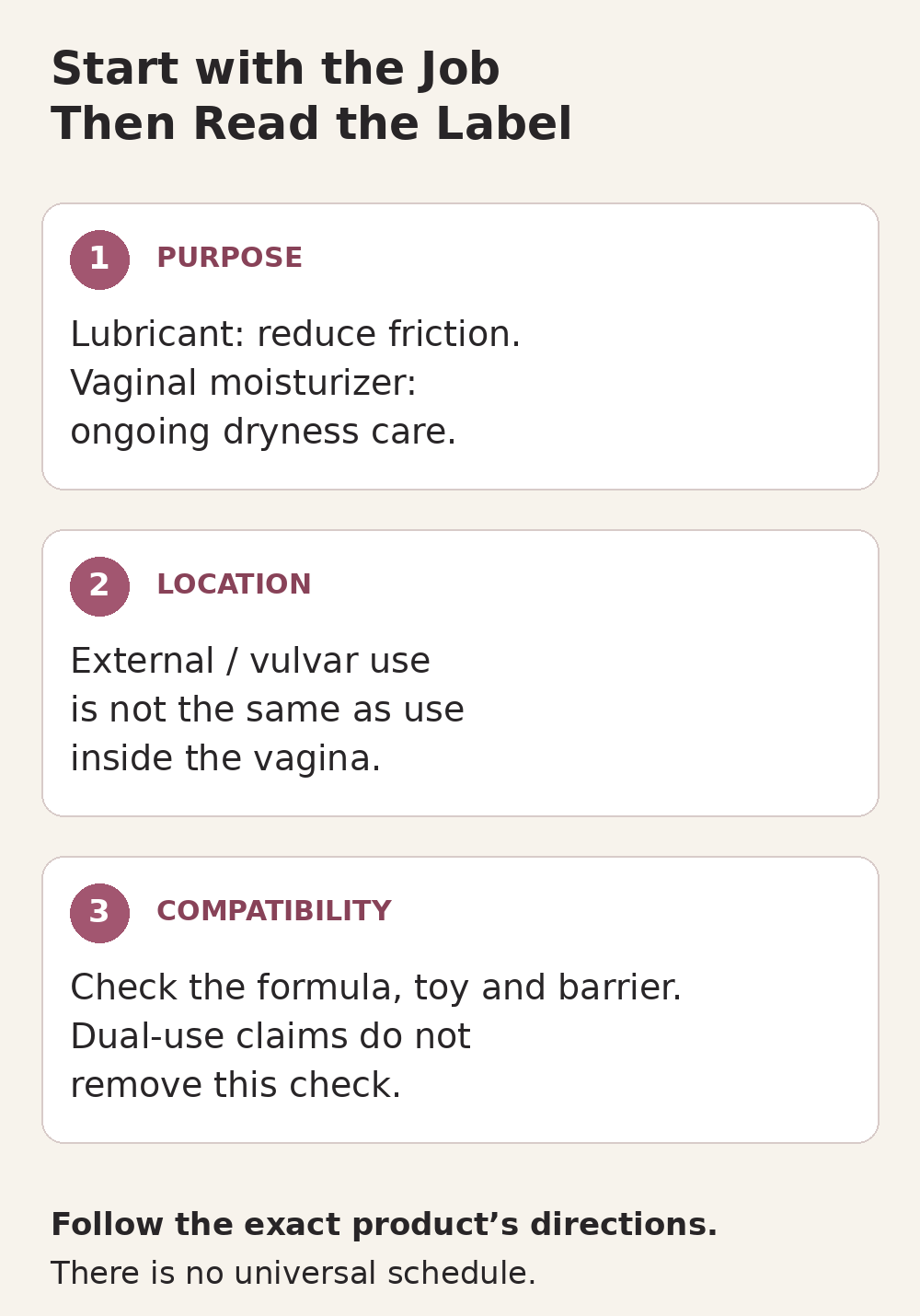
A personal lubricant is generally used when you want less friction during sexual activity, including toy use. A vaginal moisturizer is generally used on a regular schedule for ongoing vaginal dryness, whether or not you are sexually active. They are not automatically interchangeable, but some individual products are labeled for both purposes.
The useful buying question is therefore not simply “Which category is better?” It is “What does this exact product say it does, where can it be applied, and what can it be used with?” This guide is for adult women comparing nonprescription products, not a diagnosis of dryness or a treatment plan.
Two Jobs, Not Necessarily Two Bottles
Harvard Health's explanation separates ongoing moisture support from the short-term reduction of friction. A lubricant is used as needed around an activity; a vaginal moisturizer is intended for repeated use according to its directions. Neither the word “gel” nor the shape of the container tells you which job a product is designed to do.
That distinction helps you describe what you want. If the question is glide with a toy, start by checking a personal lubricant's intended use and compatibility. If dryness also bothers you outside sexual activity, that is a separate concern to discuss with a pharmacist or clinician rather than assuming more lubricant solves it.
Using a vaginal moisturizer does not automatically remove the need for lubricant during activity. Replens' manufacturer guidance says the two can be used as part of the same routine. Follow each product's directions, including any timing restrictions. This is not an instruction to mix them in a container or improvise a combined dose.
When the Package Uses Both Names
A broad category explanation cannot overrule an exact label. For example, the Replens Long-Lasting Vaginal Moisturizer leaflet for its reusable-applicator version also identifies the product as a personal lubricant for vaginal application. Its stated uses include moisturizing and supplementing natural lubrication. This is a concrete example of overlapping labeling, not evidence that every vaginal moisturizer can replace any lubricant.
Read the intended-use paragraph and directions together. A dual-purpose name does not mean you should change the amount, apply it more frequently, or ignore a waiting interval. Conversely, “moisturizing” in a lubricant's marketing does not by itself establish an ongoing vaginal-care regimen. Check the instructions supplied with the exact version you own.
External and Vaginal Are Different Instructions
The vulva is the external genital area; the vagina is the internal canal. Products intended for one location should not be assumed suitable for the other. “Intimate care” is too broad a phrase to settle that question.
Even within the same brand, directions differ. Replens External Comfort Gel specifies use on the skin outside the vagina, unlike the vaginal-application leaflet above. These examples illustrate how to read labels; they are not a recommendation that either formula is right for you.
Do not substitute an ordinary face or body moisturizer for a vaginal product. The NHS vaginal-dryness guidance advises against creams or lotions that are not made for vaginal use. A familiar skincare ingredient or a fragrance-free claim does not establish the intended application site.
Check Everything That Will Touch the Product
When a toy or condom is involved, the category name is only the first check. Read the care directions for the finished toy and the compatibility instructions for every formula and barrier you plan to use. If a moisturizer is already part of your routine, do not check only the lubricant you add later.
The reusable-applicator Replens leaflet cited above names natural rubber latex and polyisoprene condoms as compatible and says it is not compatible with polyurethane condoms. That statement belongs to that specific leaflet; it is not a rule for every Replens format, market or future formulation. If your package and a website conflict, ask the manufacturer to identify the correct instructions for your exact product rather than choosing the less restrictive answer.
For the separate material and lubricant decision, see our guide to reading compatibility labels. When comparing toys in the current product collection, look for disclosed materials and usable care instructions. A toy's size, color or price cannot tell you whether a moisturizer or lubricant is compatible.
Leave the Comparison with a Clear Next Step
Before buying, be able to finish this sentence: “I want this product for [purpose], it permits application to [location], and its directions cover [the toy or barrier, if relevant].” If any part is missing, keep the product name and packaging details and ask the manufacturer or a pharmacist. This is more useful than buying solely by “hydrating,” “natural” or “sensitive” wording.
Stop using a product that causes irritation or pain. Seek medical advice if dryness lasts for several weeks despite self-care, affects daily life, or comes with unusual discharge. Bleeding after sex, between periods or after menopause also needs assessment, as the NHS explains. Do not keep changing products to avoid investigating a persistent symptom.
If your next question is how to compare optional pleasure products after menopause, our comfort-first guide covers that separate decision. A toy is not a treatment for dryness, and choosing not to use one is equally valid.