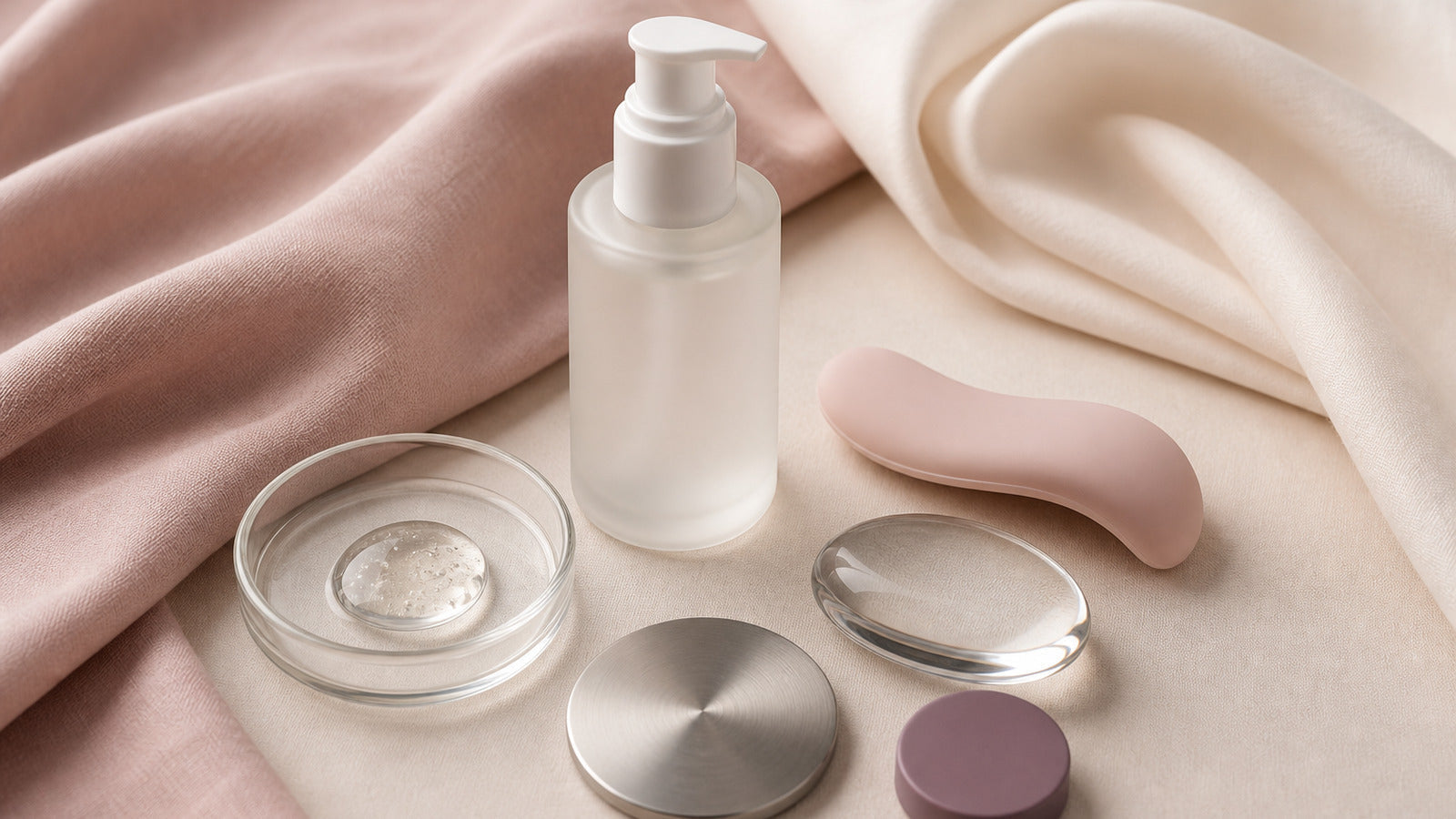
Choosing a lubricant means checking three things together: the complete product it will contact, the lubricant’s formula and any condom or barrier involved. A bottle that suits one part of that combination may conflict with another. Start with the exact labels and instructions, and leave the decision open when a detail is missing.
Identify the Product Before Choosing a Formula
Find the model name and its material and care information. Look beyond the main surface: a finished item may include coatings, seals, adhesives, buttons, a rigid core or a charging port. Instructions for a simple piece of glass cannot automatically be applied to a powered device with glass and other components.
Do not identify a material by its color, softness or shine. A soft product is not necessarily silicone, and a clear one is not necessarily borosilicate glass. If the packaging and listing disagree, ask the manufacturer to clarify the exact model before selecting a lubricant.
A useful compatibility statement names the product and the formula or lubricant category it permits. A general slogan such as “toy-friendly” leaves important questions unanswered. Keep the instructions somewhere you can revisit rather than relying on what a similar-looking product allows.
Water-Based Formulas Are a Starting Point to Check
Many product instructions recommend water-based lubricant, including for silicone contact surfaces. Water-based formulas are also an option with latex condoms. This makes them a practical category to examine first, while still checking the exact product and barrier labels.
“Water-based” describes the base of a formulation rather than every ingredient. It does not promise that a person cannot experience irritation, or that every coating, accessory and intended use is covered. Read the ingredient list, warnings, expiry date and storage information on the bottle.
If a manufacturer specifies a particular compatible formula or restricts additives, follow that guidance. Do not replace missing instructions with an assumption that every water-based product is identical.
Silicone and Hybrid Formulas Need an Extra Check
Silicone-based lubricants generally persist longer than water-based formulas and are more resistant to rinsing away. That characteristic does not make them universally compatible with adult products.
Sexual Health Oxfordshire warns that silicone lubricant can degrade silicone or realistic-feel toy materials. Do not apply it to a silicone surface unless the product manufacturer explicitly approves that combination. If either label warns against the pairing, choose a permitted alternative.
A hybrid formula may contain both water and silicone. Read the complete label rather than treating the word “water” on the front as the whole answer. Confirm compatibility for the silicone-containing formula with the maker of the finished product.
A small spot check is not a substitute for that confirmation. An unchanged-looking patch does not establish long-term compatibility, cleanliness or suitability for body contact.
Oil and Latex Are an Important Conflict
The NHS advises using water- or silicone-based lubricant with latex condoms and avoiding oil-based lubricant. A product being described as natural, plant-based or a massage oil does not override the latex warning.
Read the barrier packaging to identify its material. “Latex-free” is not a universal approval for every lubricant. Follow the instructions for that exact barrier as well as the toy and lubricant, and do not use a combination when the guidance conflicts.
Oil compatibility with a bare material also does not establish compatibility with the finished device. A coating, a soft component or a seam may have different requirements, and cleanup needs to be possible using the manufacturer’s approved method.
Use Material Information Carefully
- Silicone surfaces: check the water-based recommendation and any restrictions on silicone-containing or oil-based formulas.
- Glass and metal: verify the actual material, inspect for damage and check coatings, joins and other components. Do not turn a general material property into a promise about the whole item.
- ABS and other hard plastics: use the finished product’s instructions, including limits for surface finishes and electrical parts.
- TPE, TPR, blends or coated products: seek a specific manufacturer recommendation. Similar category names can cover different formulations.
- Unknown or mixed materials: pause until the material and compatible care method are clear.
Keep toy compatibility separate from personal tolerance. A lubricant approved for a material can still be unsuitable for an individual. Stop if it causes irritation or discomfort, and ask a pharmacist, clinician or sexual-health service about persistent symptoms or a known sensitivity.
Plan for Cleaning and Storage Too
Compatibility is only useful if the product can be cared for afterward. Check how residue should be removed, which cleaner is permitted and whether the item may be rinsed, immersed or only wiped. Remotes, cables and charging contacts may have different limits from the main product.
Do not infer water resistance from the lubricant. A formula that resists water does not protect an electronic device from moisture. Follow the device’s own exposure and drying instructions before storage or charging.
Set aside a product if its surface becomes sticky, swollen, cracked, chipped or rough, or if a component loosens. Ask the manufacturer about an unexpected change rather than covering it with more lubricant. Our cleaning and maintenance guide explains why material and construction need to be considered together.
A Short Checklist Before You Buy
- Identify the exact product, contact materials and complete construction.
- Read the lubricant’s base, ingredients and compatibility statement.
- Check any condom or barrier as a separate item.
- Resolve conflicting or missing instructions with the manufacturer.
- Confirm the cleaning, drying and storage method for the combination.
- Keep health concerns separate from shopping advice and seek individual help when needed.
A clear answer is more useful than a long list of universal claims. Compare the information in the current product listings, save the instructions for the item you choose and revisit them when changing lubricant formulas. For broader buying questions, see our first-product guide and the OMIREA Journal. This is general product information for adults, not a replacement for a manual or medical advice.