If a sex toy has become unexpectedly sticky, do not try to make it usable by adding powder or scrubbing it with a stronger cleaner. Pause intimate use, check for visible damage, and find the exact model’s care instructions. If the change remains after permitted cleaning and drying, or you cannot explain it, keep the toy out of use and ask its manufacturer or seller to assess it.
For adult women caring for a vibrator or other intimate product, the useful question is not just “How do I remove the stickiness?” It is “Has something remained on the surface, or has the surface itself changed?” You may not be able to answer that at home. This guide helps you decide what information to gather and where troubleshooting should stop.
The Same Description Can Point to Different Problems
Manufacturer guidance shows why a universal fix is a poor starting point. FUN FACTORY’s cleaning FAQ warns that silicone-based lubricant can leave residue that is difficult to remove from its toys. Separately, the LELO Beads manual warns that hand creams or silicone-based lubricants may leave that product’s silicone permanently tacky.
Those are different warnings: difficult-to-remove residue and a potentially lasting change. They are instructions for the manufacturers’ own products, not proof of what happened to yours. They also do not establish that every silicone product reacts in the same way.
Write down what you actually notice: an oily film, a tacky patch, loose flakes, a changed seam, or lint adhering to the surface. Avoid turning the observation into a diagnosis such as “fake silicone,” “bacteria” or “melting.” Appearance, touch and a material name do not identify the cause.
Choose the Next Step, Not a Stronger Treatment
First inspect without pulling, scraping or opening the device. Visible cracks, peeling, tears, exposed parts or leakage are reasons to set it aside, not to run a cleaning experiment. A motor that still switches on does not establish that its contact surface is in suitable condition.
If there is no visible damage and the care directions are clear, follow the model’s permitted cleaning and drying routine. Keep water exposure, the cleaner and any detachable parts within those instructions. Do not increase the temperature, chemical strength or soaking time because an ordinary clean has not produced the result you hoped for.
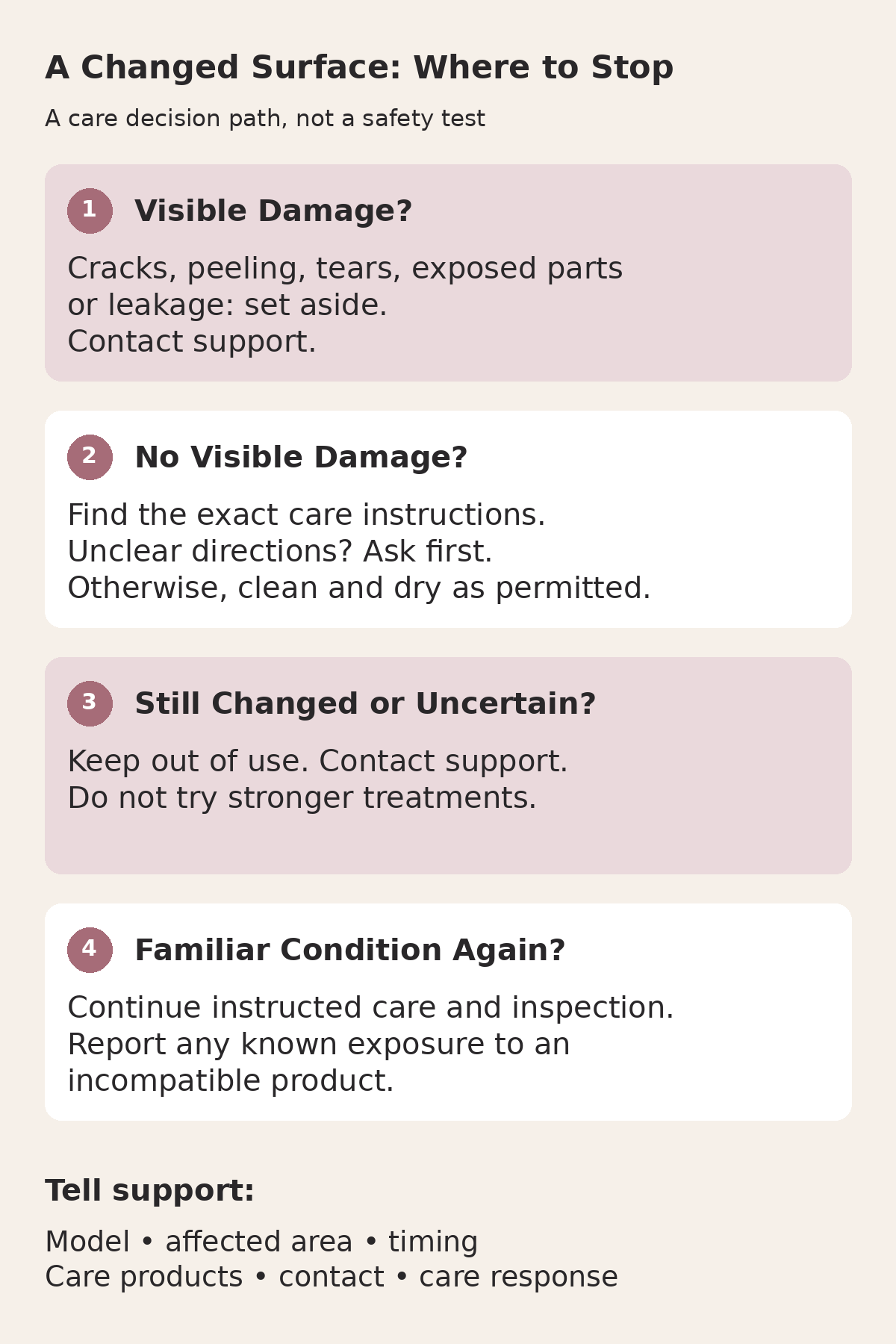
A surface returning to its familiar feel is useful information, but it is not a material test or a safety certificate. Continue the manufacturer’s routine inspection and care. If you know an incompatible product was used, report that exposure even if the surface looks better. If the tackiness persists, comes back, or leaves you uncertain, do not keep repeating treatments.
For the ordinary wash-and-dry routine, use our product-specific cleaning guide. If the question is which cleaner the instructions permit, see toy cleaner versus soap. Neither guide overrides your model’s limits.
Do Not Turn a Care Product Into a Repair
Powder can hide how a surface feels; it cannot demonstrate that a changed surface has been restored. Only use a maintenance powder if the exact product instructions call for it, not as a rescue treatment borrowed from another material. Likewise, do not sand, glue, tape or coat a damaged contact surface. The LELO Beads manual specifically excludes cleaners containing alcohol, petrol or acetone; that is a concrete reason not to apply household sticky-residue advice to an intimate product.
FUN FACTORY also warns against aggressive cleaning agents and describes possible surface or control damage from incompatible products. “More powerful” is not the same as “more appropriate.” Do not try heat or solvents to determine whether a material is genuine.
Give Support an Observation Record
A short, specific record is more useful than “it feels strange.” Keep the device out of use while an unexplained change is assessed. Photograph the product alone in good light, including the affected area and model marking; no intimate photographs are needed.
- Exact model, version or size, and when you bought it.
- Where the change appears and whether it was present when new or developed later.
- The names of the lubricant, cleaner and any creams or oils that contacted it; keep their ingredient labels available.
- How it was cleaned, dried and stored, including contact with a pouch or another object.
- Whether the change remained or returned after the permitted care routine, and any visible cracks, flaking or discoloration.
For example: “The grip area became tacky after I changed cleaner. I used [product name] as follows: [method]. After the model’s recommended cleaning and drying, the patch remains. There is [no visible damage / a visible change described here]. Is further care permitted for this exact model, or should it be replaced?” State only what you observed; you do not need to supply a chemical explanation.
Ask for a model-specific next step rather than permission to try a list of household fixes. A warranty or return assessment is separate from a conclusion about the cause. Our sex-toy returns guide explains that distinction. If the item must be retired, follow the appropriate device and battery disposal guidance rather than dismantling a sealed device.
If You Replace It, Buy Clear Care Instructions Too
Do not choose a replacement solely because a listing names a preferred material. Look for instructions covering the finished product: contact surface, controls, seams, removable parts and permitted lubricants. Before ordering, resolve any missing care information that matters to your routine.
For example, the OMIREA Whisper WS4K82 listing identifies silicone and ABS construction. That tells you it combines materials; it does not establish how any unexplained surface change should be treated. Check the exact care instructions rather than copying a method for a different silicone item.
The goal is not to rescue every toy or to replace one at the first unfamiliar feel. It is to avoid treating an unexplained change as a cleaning challenge with unlimited retries.