
Discretion can mean several things when choosing an adult product: a size that fits your storage space, understandable controls, a sound level that suits your surroundings and clear information about delivery. Start by deciding which of those details matters most to you. A compact appearance alone does not answer them all.
Make a Short Practical Brief
Write down your main requirements before browsing. For example, you may want a handheld design, a straightforward power button and a case that fits a drawer. Someone else may prioritize adjustable settings, a comfortable grip or a charging cable they can replace easily.
Keep the list short enough to use. Divide it into essentials and optional features, then compare the exact product listings. Our first-vibrator guide covers intended use, size and controls if you are still deciding where to begin.
Choose a Shape for Its Intended Use
Several designs are marketed as compact or discreet. These names describe a format rather than a guarantee about fit, noise or ease of use:
- Bullet and lipstick-style designs: compare the actual length, width and grip area, along with the stated intended use.
- Pebble-shaped devices: check the curve, button position and whether the shape is manageable to hold.
- Compact air-pulse devices: read how the mechanism and removable parts work, including their cleaning requirements.
- Wearable or remote-controlled designs: review fit instructions, the method of control and how to switch the device off directly.
- Pendant or jewelry-style designs: check the weight, charging arrangement and instructions for the complete item, including any chain or removable pieces.
Our guide to vibrator types explains the broader categories. Do not assume a small or rounded product is suitable for insertion; follow the purpose stated by its manufacturer. Appearance also does not establish whether an item may be taken through a particular border or security checkpoint.
Measure the Whole Storage Setup
Product photographs can make size difficult to judge. Use the listed measurements and a ruler, and check whether the dimensions include a cap, base or attachment. Consider the weight and the space needed for a cable, remote or protective case.

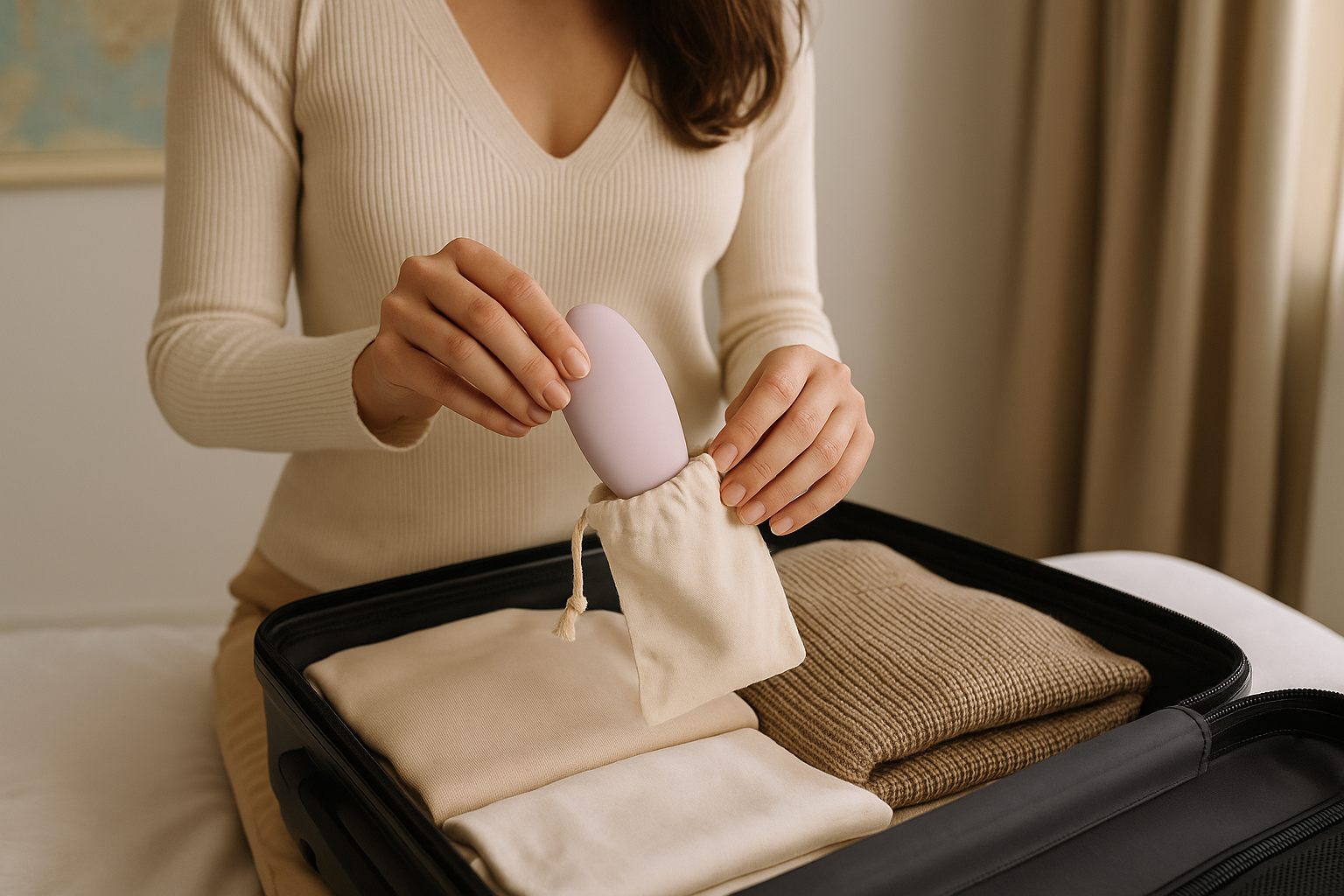
Before choosing a storage pouch, check the product’s instructions. It should let you store the item clean and fully dry without pressing its controls or damaging its surface. A pouch may keep belongings organized, but it should not be treated as proof of hygiene, impact protection or guaranteed privacy.
Ask What Supports a Quietness Claim
A description such as “whisper-quiet” is more useful when accompanied by a test method. Ask which setting was tested, how far away the measuring equipment was and what the surrounding noise level was. Compare readings only when their conditions are meaningfully alike.
Reviews can help identify questions to ask. Look for descriptions of the exact setting and whether the reviewer noticed a steady hum, a changing pulse or an unexpected rattle. A promise that nobody in another room will hear a product cannot account for every home or listening situation.
Try to establish the features you need before paying. Read the return policy before opening or testing a purchase, and clarify any uncertainty about eligibility with support.
Check the Power Button and Travel Lock
Find out how the device starts, changes settings and stops. A one-button design may be convenient, but the number of buttons does not tell you how easy the sequence will be to remember. Ask whether you must cycle through settings to reach the one you want.
If a travel lock matters to you, confirm that the exact model has one and read the correct locking and unlocking instructions. A storage cap and an electronic lock are different features. Check how the device indicates that it is locked, rather than assuming that a long press works the same way on every product.
For an app-connected model, review whether an account is required, what works without a connection and which app permissions are requested. Check its privacy information and how to remove paired access when appropriate. A remote-control feature should come with clear instructions about who can operate the product.
Read Charging and Care Instructions Together
Confirm the supplied accessories, charging connection, recommended power source and stated runtime. Ask which setting the runtime describes. If a special cable or base is needed, find out how to obtain a replacement before you rely on it for a trip.
Read water-exposure limits separately from the material description. A silicone surface does not establish whether the finished device, remote or charger can be rinsed or immersed. Use the specified cleaning method and compatible accessories; avoid applying blanket advice from a different model.
Our care and storage guide provides a checklist. If you will be away from home, make sure you can complete the required cleaning and drying routine where you are staying.
Plan for Travel and Delivery
Before packing, check the rules for your departure point, transit stops, destination and carrier. Review the exact item, its battery type and any liquids you intend to bring. Follow official guidance, and ask the relevant authority when the answer is unclear. Product marketing such as “travel-ready” does not replace those checks.
For an online purchase, confirm the parcel labeling, payment descriptor and delivery arrangements that matter to you. Our discreet-shipping guide explains those separate questions.
When browsing the current collection, use your brief to narrow the options. Clear specifications, workable controls and a care routine you can follow provide a useful basis for choosing a product that fits your everyday arrangements.