Some women report temporary reduced genital sensitivity after using a vibrator. That is not the same as evidence that ordinary vibrator use permanently destroys sensation. But an article cannot explain your symptoms or guarantee that every device and way of using it is risk-free. If you notice numbness, pause rather than increasing the intensity to overcome it.
For adult women wondering whether a familiar device has changed their sensitivity, it helps to separate three questions: what you are noticing, what research actually measured, and whether the change needs professional attention. You do not need to buy a replacement to answer the first two.
Temporary Changes Are Not a Permanent-Damage Diagnosis
The International Society for Sexual Medicine (ISSM) describes reduced sensitivity after vibrator use as generally temporary. It also says that online claims of “dead vagina syndrome” are not substantiated by scientific medical studies. The phrase is not a useful explanation for an individual symptom.
A 2018 clinical narrative review discusses sensory adaptation as a possible explanation for temporarily reduced responsiveness and considers long-term desensitization unlikely. This is a review, not a new experiment proving permanent harm impossible. Its literature search ended in 2016. Reassurance should not become a reason to dismiss a change that persists.
Read the Numbers With the Right Denominator
The frequently cited 2009 study by Herbenick and colleagues surveyed 2,056 U.S. women ages 18–60. Among women who had ever used a vibrator, 16.5% reported ever experiencing genital numbness; 0.5% reported numbness lasting a day or longer. Both percentages refer to vibrator-ever-users, not just the women who reported numbness.
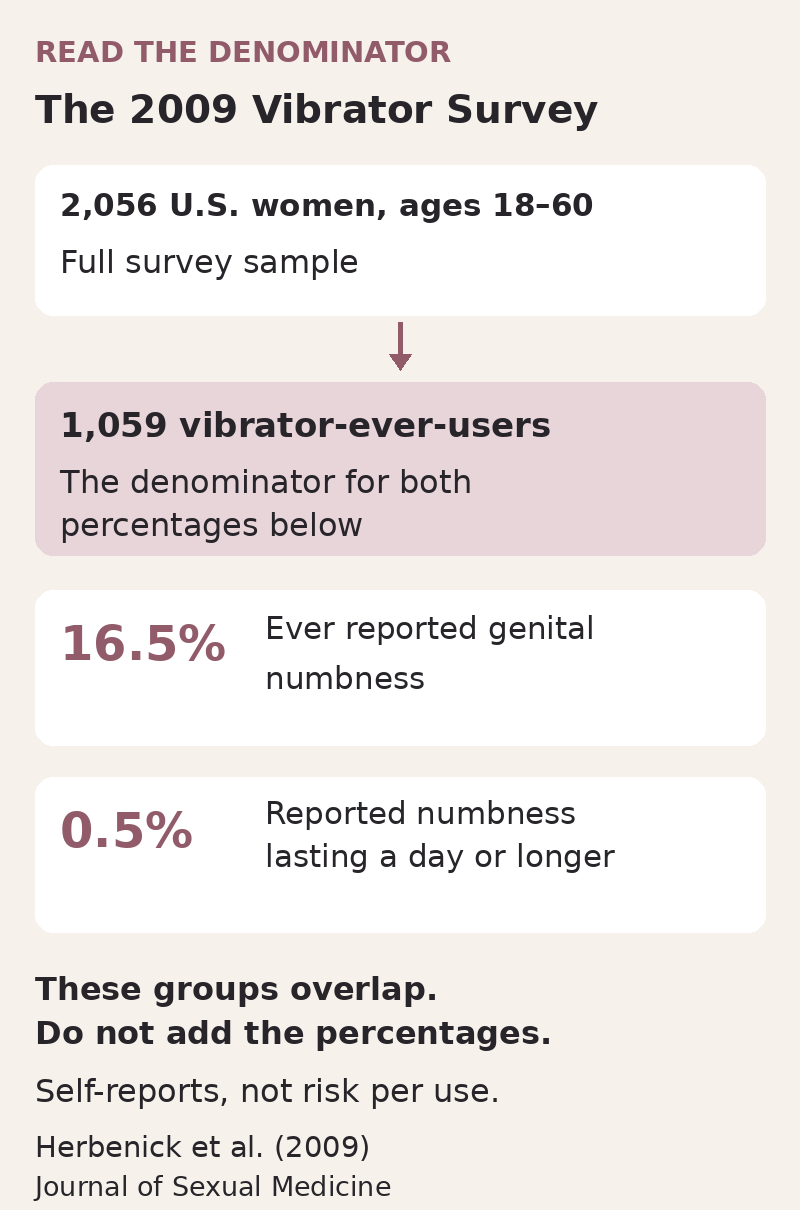
These were self-reports collected in a cross-sectional survey, not examinations of nerve function or lifetime follow-up. The findings cannot establish what caused an individual episode, predict your recovery time or certify a particular product. A duration category in a survey is also not an instruction to wait that long before seeking care.
Describe the Change Before Blaming the Toy
“I prefer this setting,” “I find another kind of touch less satisfying” and “I cannot feel normal sensation” are different statements. Use the description that fits, rather than treating them all as proof of damage. Our guide to orgasm variation addresses expectations about response; it is not a substitute for assessment of altered sensation.
A short note can help you explain a concern without diagnosing it: when it began, whether it occurs only after vibrator use or at other times, whether it resolves, and whether there is pain or a visible change. Describe the model and setting if relevant. You do not have to repeat an uncomfortable experience to gather more evidence.
Columbia Health’s Go Ask Alice! also notes that ongoing difficulties with sexual response may be unrelated to a vibrator. A change happening after use does not, by itself, identify its cause.
Do Not Turn Numbness Into a Shopping Problem
A stronger motor, a different rhythm or a larger mode count is not a treatment for lost sensation. If the issue is actually an uncomfortable setting rather than numbness, our low-intensity control guide explains how to distinguish intensity from patterns and saved settings. It does not promise that a particular adjustment will resolve a symptom.
When you are choosing a product, compare documented controls and intended use, not a promise that it will prevent desensitization. The current product listings are a place to examine product specifications, not evidence of medical suitability. A selectable mode count says nothing about whether a device will avoid numbness for you. There is no reason to replace a toy simply because an online headline makes you anxious.
When to Ask for Help
ISSM advises seeing a healthcare professional if numbness continues and seeking medical attention for other side effects such as pain, irritation, swelling or cuts. Do not dismiss these as a routine part of getting used to a device. You can seek advice whenever the change concerns you; there is no need to complete a waiting period or try stronger stimulation first.
This is general education, not a diagnosis or a treatment plan. The useful balance is neither “a vibrator has ruined my sensitivity” nor “a vibrator could never be involved.” Take the symptom seriously, keep the evidence in proportion, and let your next step be guided by what you are experiencing rather than by product marketing.